
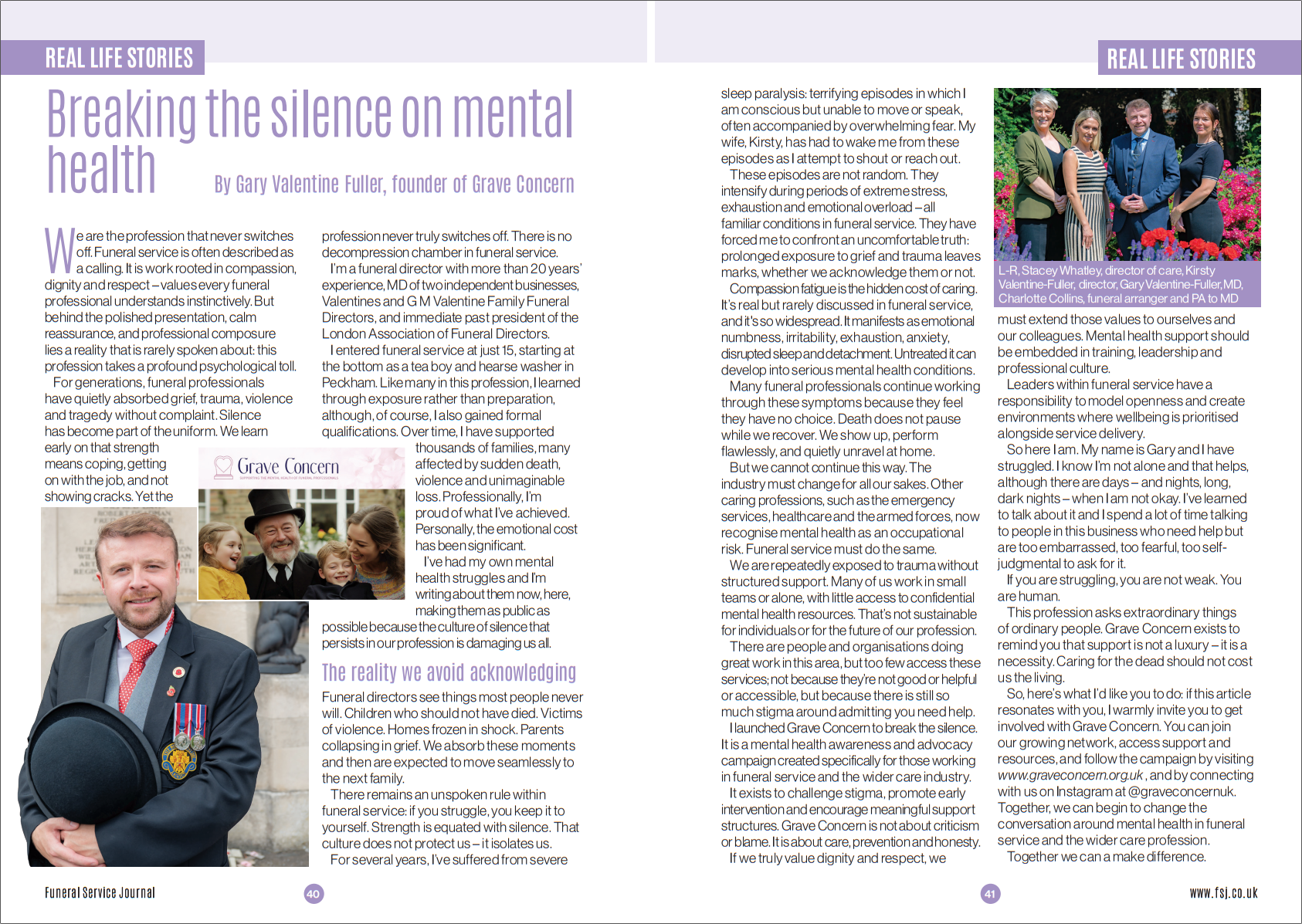
Breaking the silence on mental health

We are the profession that never switches off. Funeral service is often described as a calling. It is work rooted in compassion, dignity and respect – values every funeral professional understands instinctively. But behind the polished presentation, calm reassurance, and professional composure lies a reality that is rarely spoken about: this profession takes a profound psychological toll.
For generations, funeral professionals have quietly absorbed grief, trauma, violence and tragedy without complaint. Silence has become part of the uniform. We learn early on that strength means coping, getting on with the job, and not showing cracks. Yet the profession never truly switches off. There is no decompression chamber in funeral service.
I’m a funeral director with more than 20 years’ experience, MD of two independent businesses, Valentines and G M Valentine Family Funeral Directors, and immediate past president of the London Association of Funeral Directors.
I entered funeral service at just 15, starting at the bottom as a tea boy and hearse washer in Peckham. Like many in this profession, I learned through exposure rather than preparation, although, of course, I also gained formal qualifications. Over time, I have supported thousands of families, many affected by sudden death, violence and unimaginable loss. Professionally, I’m proud of what I’ve achieved. Personally, the emotional cost has been significant.
I’ve had my own mental health struggles and I’m writing about them now, here, making them as public as possible because the culture of silence that persists in our profession is damaging us all.
The reality we avoid acknowledging
Funeral directors see things most people never will. Children who should not have died. Victims of violence. Homes frozen in shock. Parents collapsing in grief. We absorb these moments and then are expected to move seamlessly to the next family.
There remains an unspoken rule within funeral service: if you struggle, you keep it to yourself. Strength is equated with silence. That culture does not protect us – it isolates us.
For several years, I’ve suffered from severe sleep paralysis: terrifying episodes in which I am conscious but unable to move or speak, often accompanied by overwhelming fear. My wife, Kirsty, has had to wake me from these episodes as I attempt to shout or reach out.
These episodes are not random. They intensify during periods of extreme stress, exhaustion and emotional overload – all familiar conditions in funeral service. They have forced me to confront an uncomfortable truth: prolonged exposure to grief and trauma leaves marks, whether we acknowledge them or not.
Compassion fatigue is the hidden cost of caring. It’s real but rarely discussed in funeral service, and it’s so widespread. It manifests as emotional numbness, irritability, exhaustion, anxiety, disrupted sleep and detachment. Untreated it can develop into serious mental health conditions.
Many funeral professionals continue working through these symptoms because they feel they have no choice. Death does not pause while we recover. We show up, perform flawlessly, and quietly unravel at home.
But we cannot continue this way. The industry must change for all our sakes. Other caring professions, such as the emergency services, healthcare and the armed forces, now recognise mental health as an occupational risk. Funeral service must do the same.
We are repeatedly exposed to trauma without structured support. Many of us work in small teams or alone, with little access to confidential mental health resources. That’s not sustainable for individuals or for the future of our profession.
There are people and organisations doing great work in this area, but too few access these services; not because they’re not good or helpful or accessible, but because there is still so much stigma around admitting you need help.
I launched Grave Concern to break the silence. It is a mental health awareness and advocacy campaign created specifically for those working in funeral service and the wider care industry.
It exists to challenge stigma, promote early intervention and encourage meaningful support structures. Grave Concern is not about criticism or blame. It is about care, prevention and honesty.
If we truly value dignity and respect, we must extend those values to ourselves and our colleagues. Mental health support should be embedded in training, leadership and professional culture.
Leaders within funeral service have a responsibility to model openness and create environments where wellbeing is prioritised alongside service delivery.
So here I am. My name is Gary and I have struggled. I know I’m not alone and that helps, although there are days – and nights, long, dark nights – when I am not okay. I’ve learned to talk about it and I spend a lot of time talking to people in this business who need help but are too embarrassed, too fearful, too self-judgmental to ask for it.
If you are struggling, you are not weak. You are human.
This profession asks extraordinary things of ordinary people. Grave Concern exists to remind you that support is not a luxury – it is a necessity. Caring for the dead should not cost us the living.
So, here’s what I’d like you to do: if this article resonates with you, I warmly invite you to get involved with Grave Concern. You can join our growing network, access support and resources, and follow the campaign by visiting graveconcern.org.uk, and by connecting with us on Instagram at @graveconcernuk. Together, we can begin to change the conversation around mental health in funeral service and the wider care profession.
Together we can a make difference.
This article is reproduced here with the kind permission of Funeral Service Journal.