
What is Grave Concern?

Funeral professionals play a crucial role in supporting grieving families during some of the most challenging times of their lives. However, the emotional and psychological toll of their work is often overlooked.
The Grave Concern initiative was set up by Gary Valentine to mark his inauguration as president of the London Association of Funeral Directors in 2024.
Grave Concern aims to shed light on the mental health challenges faced by funeral professionals in the UK and offers strategies to preserve and improve their mental well-being.
By addressing the challenges head-on, we can create a more supportive and sustainable environment for funeral professionals, ensuring they can continue their vital work with resilience and compassion.
View our video

View our video

The emotional toll of the profession
Funeral professionals are regularly exposed to death, grief, and trauma. This constant exposure can lead to several mental health issues, including:
- Compassion fatigue: The continuous need to provide emotional support to grieving families can lead to compassion fatigue, a state of physical and emotional exhaustion that reduces the ability to empathise with clients.
- Burnout: Long hours, unpredictable workloads, and the high emotional demands of the job can result in burnout, characterised by chronic stress, fatigue, and a sense of detachment from work.
- Post-traumatic stress disorder (PTSD): Funeral professionals often encounter traumatic situations, such as handling the victims of accidents or crimes. This exposure can lead to PTSD, with symptoms including flashbacks, severe anxiety, and uncontrollable thoughts about the event.

Recognising the signs

It is important to recognise the signs of mental health issues early. For funeral professionals, the symptoms may include:
- Persistent feelings of sadness or depression
- Difficulty concentrating or making decisions
- Irritability or mood swings
- Physical symptoms such as headaches or stomach issues
- Withdrawal from social interactions

Preserving and improving mental health
To support the mental health of funeral professionals, several strategies can be implemented:
- Professional counseling and support groups: Access to professional counseling and support groups can provide a safe space for funeral professionals to express their feelings and receive guidance on coping mechanisms.
- Regular mental health training: Training sessions on mental health awareness can help funeral professionals recognize the signs of mental health issues in themselves and their colleagues and learn effective coping strategies.
- Work-life balance: Encouraging a healthy work-life balance is essential. This can include setting boundaries for work hours, taking regular breaks and ensuring time off to recharge.
- Peer support programs: Establishing peer support programs within funeral homes can foster a supportive environment where colleagues can share their experiences and offer mutual support.
- Mindfulness and stress-reduction techniques: Practices such as mindfulness, meditation and yoga can help reduce stress and improve overall mental well-being.
Families
The sometimes harrowing nature of work in the industry can also take its toll on the families of funeral professionals, who may inevitably be ‘touched by death’.
Partners may feel neglected or pushed away.
Children may have bad dreams, become distant, or take an unnatural interest in death. Like the families of emergency service workers, their mum or dad is often called out in the middle of the night or may be absent at times when families are traditionally together, such as Christmas.
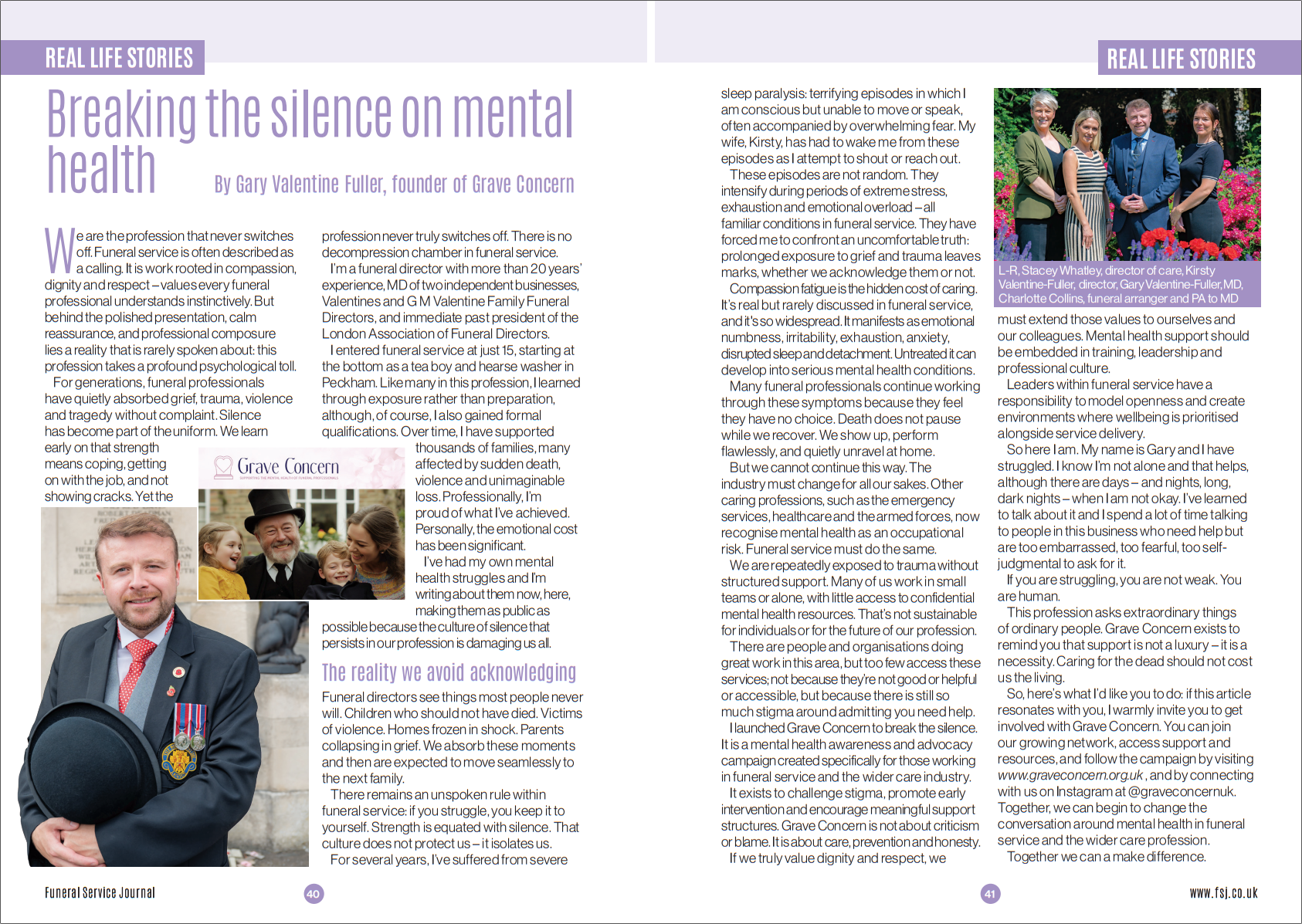
Breaking the silence on mental health
For years, our profession has carried more than most people will ever see.
Behind the calm voices, polished shoes and composed faces, many funeral professionals quietly absorb trauma, grief, violence and shock – and then move straight on to the next family. No decompression. No pause. No permission to struggle.
In a recent edition of Funeral Service Journal, Grave Concern founder Gary Valentine shared his own experience of this reality – including living with anxiety, burnout, pressure, stress and sleep paralysis – not for sympathy, but because silence does not protect us. It isolates us.
Grave Concern was created to break that silence.
Our plans
Over the next few months we’ll be inviting funeral directors to attend specially tailored workshops led by our charity partners. Professional counsellors and trainers will help raise awareness of potential mental health problems for those working in the funeral industry and discuss strategies for improving mental well-being.
These workshops will be hosted at different venues nationwide. We’ll post details here, as well as communicating with members of the profession in other ways.
We’ll also be arranging coffee mornings and other social events, where funeral directors can come together, get to know each other better, and discuss some of the issues raised by the Grave Concern initiative.

How you could help
At this stage, Grave Concern is a campaign, not a charity, so we’re not seeking donations or doing any kind of fund-raising on our own behalf.
But if you work in the funeral profession and would like to offer your assistance with our efforts, we’d be glad to hear from you. Please see our contact details below.
In addition, we hope to be organising some informal meetings, where like-minded members of the profession can discuss the way forward for the campaign.
For more information about this, please follow us on Instagram or sign up to our newsletter, at the bottom of this page.




Charity partners
To help us achieve our aims, we’re working with two local branches of the mental health charity Mind, and with PTSD999, a not-for-profit social enterprise that works primarily with emergency service workers but also with others whose professions may sometimes involve traumatic circumstances.
These organisations have provided us with advice and literature, as well as assistance in putting together some bespoke training on dealing with stress, anxiety and grief for funeral professionals. For our part, we’re keen to do some fundraising for them, including organising sponsored events and collections. To get the ball rolling, Grave Concern founder Gary Valentine has recently “jumped out of a plane” in support of West Kent Mind.
Ways to contact us
info@graveconcern.org.uk
01689 798448
Grave Concern
c/o Valentine’s Family Funeral Directors, 262 High Street, Orpington BR6 0NB
Find us on social media

We’ll be talking about the Grave Concern campaign on social media, beginning with Instagram. Please click or tap the icon below to visit our Instagram page – and we’d be grateful if you could follow us there.
Stay updated
Let us know your name and email address and we’ll add you to the mailing list for our monthly newsletter, updating you on the progress of the Grave Concern initiative.
The images on this page have been created using generative AI and are not intended to represent specific individuals. Any resemblance to actual members of the funeral profession or their families is entirely coincidental.